
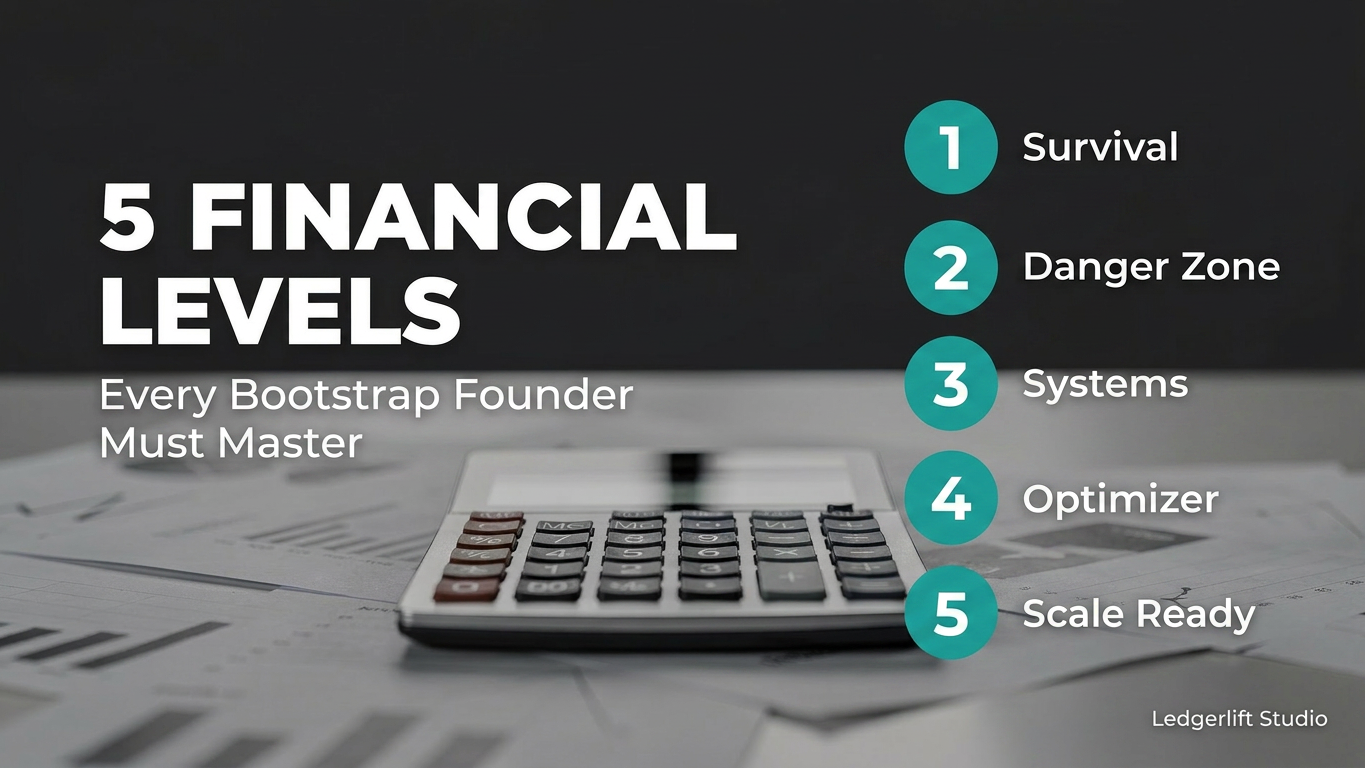
Bootstrap founders move through five Bookkeeping Maturity Stages on the way to real profitability — five stages of system maturity, not five revenue milestones: tracking money in your head, mixing personal and business funds without realizing it, separating the business and running real monthly closes, using clean numbers to make pricing and hiring decisions, and finally running on systems that don’t need you to operate them. Most founders get stuck at the Catch-Up stage — early revenue creates a false sense of security while the actual financial picture stays invisible.
I’ve watched hundreds of bootstrap founders hit their first $20K month, feel unstoppable, then panic three months later when they realize they have no idea if they’re actually profitable.
The pattern repeats everywhere. A founder hits a revenue milestone. Feels like they’ve made it. Then discovers the business is leaking cash through holes nobody bothered to plug — the same holes that show up when bootstrap founders fail at bookkeeping for reasons that have nothing to do with effort.
Financial maturity isn’t about revenue. It’s about systems. Most founders are running early-stage systems against later-stage problems — and the gap is where the money disappears.
The 5 Bookkeeping Maturity Stages Bootstrap Founders Actually Move Through
These aren’t revenue targets. They’re system maturity stages. You can have $100K in revenue running Foundation-stage systems. You can have $30K in revenue with Systemized-stage discipline. The revenue ranges below are patterns, not rules — but the system requirements at each stage are non-negotiable if you want to survive the next one.
Most founders I meet are running Catch-Up-stage revenue with Foundation-stage systems. That’s where things break.
Stage One: Foundation — Tracking It in Your Head ($0–$10K)
You’re tracking money mentally or in a basic spreadsheet. Revenue is sporadic. Every dollar matters because there aren’t many of them.
The good news: your financial complexity matches your revenue complexity. You can see all of it from here. A personal bank account doubling as a business account, credit card statements as your expense log, mental math for profitability — all of it actually works at this stage, because transaction volume is low enough that you remember every payment and every major expense.
The trap: founders assume these habits will scale. They don’t.
Stage Two: Catch-Up — Revenue Without Visibility ($10K–$50K)
This is where founders get into financial trouble, even when revenue looks healthy.
Consistent income. Multiple revenue streams. Regular expenses. Maybe a contractor or two. The complexity multiplied by 10x, but the systems stayed the same. Mental math stops working when you have 47 transactions last month instead of 7.
The symptoms are familiar: revenue is up but you feel broke, you can’t explain where specific dollars went, business and personal expenses are mixed, you don’t actually know your margin, and pricing decisions get made on a feeling rather than a number.
Revenue momentum makes you feel successful while the foundation underneath stays unbuilt. You’re too busy growing to notice the bleeding — and most founders get stuck here because fixing the system feels like busy work when sales calls are coming in. But revenue without a system is just expensive chaos. If the backlog has already gotten away from you, a Bookkeeping Reset is the fastest way out of the Catch-Up stage, not a way to skip past it.
Stage Three: Stabilizing — Separation and the Monthly Close ($50K–$150K)
You finally separate business and personal money. Expenses get tracked in real categories. You run an actual monthly close and can see profit and loss.
You can answer the basic questions now: what did I make last month, what did I spend, am I profitable. The work shifts here — instead of just recording what happened, you start planning what should happen. Budgets, cash flow forecasts, profit targets.
The systems at this stage: a separate business bank account, monthly P&L statements, real bookkeeping software, a regular financial check-in. The new problem that shows up: you have data, but you’re not using it to decide anything yet.
Stage Four: Systemized — Numbers That Drive Decisions ($150K–$300K)
Your systems start generating insight instead of just records. You know your margin by service or product line. You can model the financial impact of a decision before you make it.
You’re not just tracking money anymore — you’re directing how it moves through the business. You can answer which clients or products are actually most profitable, what it really costs you to deliver each service, how much you can afford to spend on a new hire, and what revenue you need to hit a specific profit target.
The shift is from reactive tracking to proactive planning. The books stop being compliance paperwork and start being a decision-making tool.
Stage Five: Scaling — A System That Runs Without You ($300K+)
The financial system runs independently. Monthly closes happen on a schedule without you chasing them down. You have forward-looking dashboards. More than one person can read the numbers and act on them.
Decisions get made from financial models, not gut feel. Cash flow forecasts drive hiring and investment timing. Profit optimization is systematic, not occasional.
Most importantly: the system could survive without you personally running it.
How to Find Out Which Stage You’re Actually At
Stop guessing. Here’s the honest test: can you tell me your exact profit for last month? Not revenue minus the obvious expenses — actual profit, including the costs you forgot about.
If your answer started with “approximately” or “around” or “well, it depends how you count,” you’re not where you think you are. Most founders running $50K in revenue believe they’re at the Stabilizing stage. They’re usually at the Catch-Up stage with more transactions.
If you’re at the Foundation or Catch-Up stage and want a structured way to build the foundation, the Foundation Kit walks through exactly that — $27, available now. If your books are more than a couple months behind and you need them cleaned up before you can build anything on top of them, the Bookkeeping Reset is the on-ramp — not the destination, but the fastest way to get to a clean starting point for a real system.
The gap between where you think you are financially and where your systems actually are is exactly where the money disappears.
Frequently Asked Questions
A: Foundation (tracking money mentally with no real system), Catch-Up (generating revenue without financial visibility), Stabilizing (separating business finances and running monthly closes), Systemized (using clean numbers to drive pricing and hiring decisions), and Scaling (running on systems that operate independently of the founder). Most founders get stuck at the Catch-Up stage.
A: Early revenue creates a false sense of security. The business looks successful from the outside while the financial system underneath stays broken. Fixing the system feels like a distraction from growth — until the lack of one starts costing real money in missed deductions, pricing mistakes, and cash flow surprises.
A: Ask yourself if you can state your exact profit for last month without hedging. If you can’t, your systems are behind your revenue. A short diagnostic can pinpoint exactly where the gap is and what to build next — so you know whether you need to clean up first or start building the system directly.
Not sure which stage you’re actually at? Take the free diagnostic and find out in a few minutes — no guessing required.