
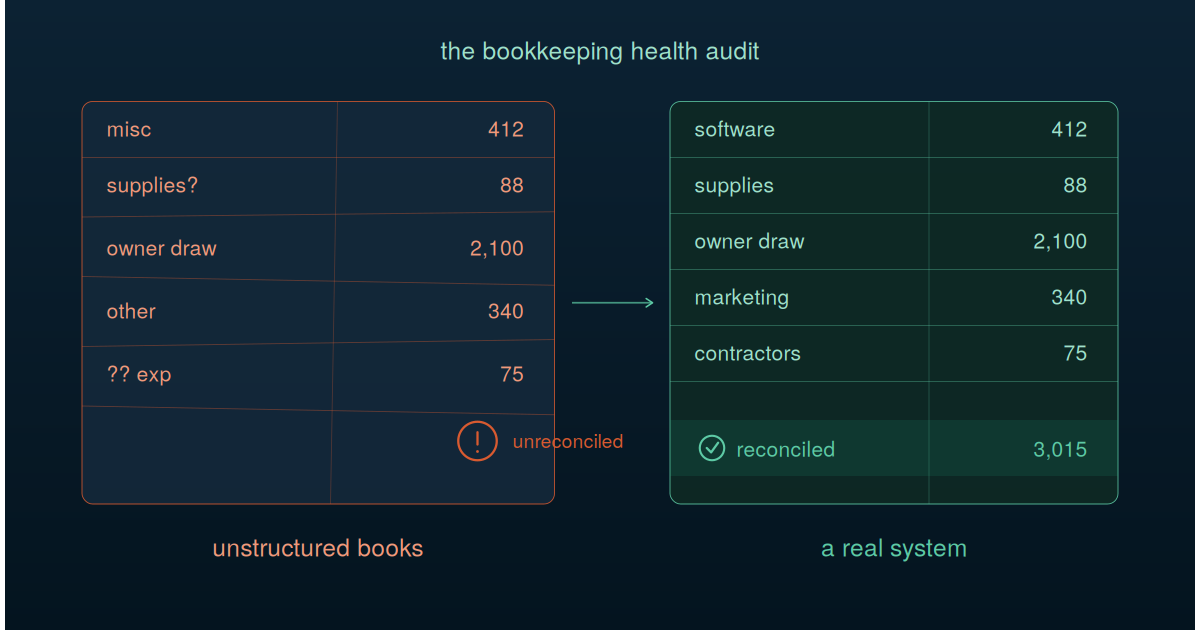
Most founders don’t know their books are broken until something forces them to look — a tax deadline, a cash crunch, or a moment where they realize they genuinely don’t know if they made money last month.
That’s not a bookkeeping problem. That’s a systems problem. And it shows up in patterns you can spot before it costs you.
Here’s how to run a bookkeeping health audit on your own business — and what to do when you find something.
What Does a Bookkeeping Health Audit Actually Check?
A bookkeeping health audit checks whether your financial record keeping gives you accurate, usable information — or whether it’s just recording transactions with no system behind it. It checks three things: whether your data is complete, whether it’s categorized in a way that means something to your business, and whether it’s organized so you can actually answer basic financial questions without hunting for the answer.
The goal isn’t to find errors. It’s to find gaps in the underlying structure — the places where the system fails to surface what you need to see.
7 Signs Your Bookkeeping Is a Mess
These aren’t accounting mistakes. They’re structural signals — indicators that your books aren’t built to run your business.
1. You Can’t Answer Basic Money Questions Without Calling Your Accountant
If someone asked you right now whether you’re profitable, what your biggest expense category is, or what you made last quarter — could you answer in under two minutes? If the answer requires pulling reports, calling someone, or guessing, your system isn’t built to make that information accessible. The data exists. The structure doesn’t.
2. Your P&L Doesn’t Match What You Know Happened This Month
You had a strong month. Revenue came in, you paid some big invoices, things felt busy. But when you pull the P&L, the numbers don’t match your memory of the month. That gap usually means your chart of accounts doesn’t reflect how your business actually operates — expense misclassification is landing transactions in the wrong buckets, or timing is off in ways that compound over time.
3. You’ve Never Reconciled — or Reconciliation Terrifies You
Reconciliation is the process of confirming your books match your actual bank activity. If it’s never been done, or if you avoid it because the last time you tried it didn’t balance and you don’t know why, that’s a sign the system doesn’t have a reliable baseline. Everything built on top of it is suspect.
4. You Have One Bank Account Doing Three Jobs
Operating expenses, owner draws, tax reserves, and client payments all running through the same account — with no system to separate them — means your books can’t tell the difference between a business expense and a personal withdrawal. The structure isn’t there to make those distinctions visible.
5. Tax Season Is Always a Cleanup Project
If every April involves reconstructing the prior year because the books weren’t maintained in a way your accountant can use, that’s not an annual catch-up task. It’s a signal that the system isn’t built to stay current. The cleanup cost — in money, time, and stress — is the symptom. The missing structure is the cause.
6. You’re Guessing at Profit Margins
If you don’t know your margins by product, service line, or client type, your chart of accounts and job-costing structure aren’t built to track them. You might know your total revenue. You probably don’t know what it costs to generate specific types of it — which means you can’t make pricing or capacity decisions with real numbers behind them.
7. Your Books Were Set Up Once and Never Revisited
Initial setup — whether you did it yourself or someone did it for you at the start — reflects the business you had then. If your offerings, pricing, team size, or revenue model have changed and the books haven’t been rebuilt to match, the structure is out of date. You’re recording current activity in a system built for a version of your business that no longer exists.
If three or more of these showed up in your audit, the underlying architecture is the problem — not the individual entries. The diagnostic will tell you exactly what kind of rebuild your books need.
→ diagnostic.ledgerliftstudio.com
What These Signs Actually Mean (It’s a Systems Problem, Not a Math Problem)
Every item on that list looks like a bookkeeping problem on the surface. It’s not. Each one is a structural signal — evidence that whoever built the system didn’t design it for how you’re running your business.
Wrong categorization isn’t a data entry error. It means your chart of accounts isn’t built to distinguish what matters to you. Tax season chaos isn’t disorganization. It means no close process exists to keep the books audit-ready month to month. Reconciliation anxiety isn’t a skill gap. It means the underlying structure has never been stabilized enough to make reconciliation straightforward.
If your audit turned up several of these signs and you’re not sure whether cleanup or a full reset is the right move, this breaks down exactly when Reset Service comes before your system →
The pattern across all seven signs is the same: the data is there, but the architecture isn’t. That’s a systems problem — and systems problems don’t get fixed by trying harder with the same setup. They get fixed by rebuilding the setup.
How to Run Your Own Bookkeeping Health Audit (Step-by-Step)
Use this as a structured walkthrough. You don’t need an accountant to run it — you need honest answers.
Step 1: Pull your last three months of P&L reports. If you can’t pull them, or they don’t exist, that’s your first finding. Log it and move on.
Step 2: Check for completeness. Do the totals match your bank deposits and payments for those months? Any unexplained gaps indicate missing transactions or unreconciled periods.
Step 3: Audit your chart of accounts. Open your account list (in QuickBooks, Wave, or wherever your books live). Does every category reflect something meaningful to your business? Are there catch-all accounts like “miscellaneous” or “other expenses” with significant balances? Those are structural gaps.
Step 4: Run a reconciliation status check. When was the last time your bank accounts were reconciled? If the answer is “I don’t know” or “never,” log it.
Step 5: Test your reporting speed. Can you pull a current P&L, a cash flow summary, and an accounts receivable report in under five minutes? If it takes longer — or if you don’t know where to find them — your system isn’t built for fast access.
Step 6: Check your account separation. Do you have dedicated accounts for operating expenses, owner draws, and tax reserves — or is everything running through one account? Single-account operations are a structural liability.
Step 7: Log your findings. Don’t try to fix anything yet. Just record what you found in each step. The pattern of findings tells you what kind of systems rebuild you’re dealing with.
What to Do With Your Audit Results
If your audit turned up one or two flags, you may be able to address them with targeted cleanup — tightening your chart of accounts, catching up on reconciliation, or separating your banking structure.
If you found three or more, the issue isn’t individual problems. It’s the underlying architecture. Fixing line items without addressing the structure means the same problems come back — because the system that created them is still in place.
The diagnostic tool is built to take your audit findings and route you to the right next step: whether that’s a foundational kit to rebuild from scratch, a monthly close system to stabilize what you have, or a full reset before you migrate to a real database setup.
Find out exactly where your books are and what they need: → diagnostic.ledgerliftstudio.com
LedgerLift Studio builds custom financial database systems for bootstrap founders. Real numbers. Real systems. Built from real books.
FAQ
A: Look for these signals: you can’t answer basic financial questions quickly, your P&L doesn’t match your memory of the month, you’ve never reconciled or avoid it, tax season requires a cleanup project every year, and your books were set up once and never updated as your business changed. Any three of these together indicate a structural problem — the underlying architecture wasn’t built to run your business. That’s not a data entry issue. It’s a systems issue.
A: A financial health audit checks whether your bookkeeping system is structured to give you accurate, accessible information. Pull your last three months of P&L reports, check for completeness against your bank activity, audit your chart of accounts for meaningful categories, verify your reconciliation status, test how quickly you can pull key reports, and check whether your banking is properly separated. The pattern of findings tells you whether you need targeted fixes or a full systems rebuild.