
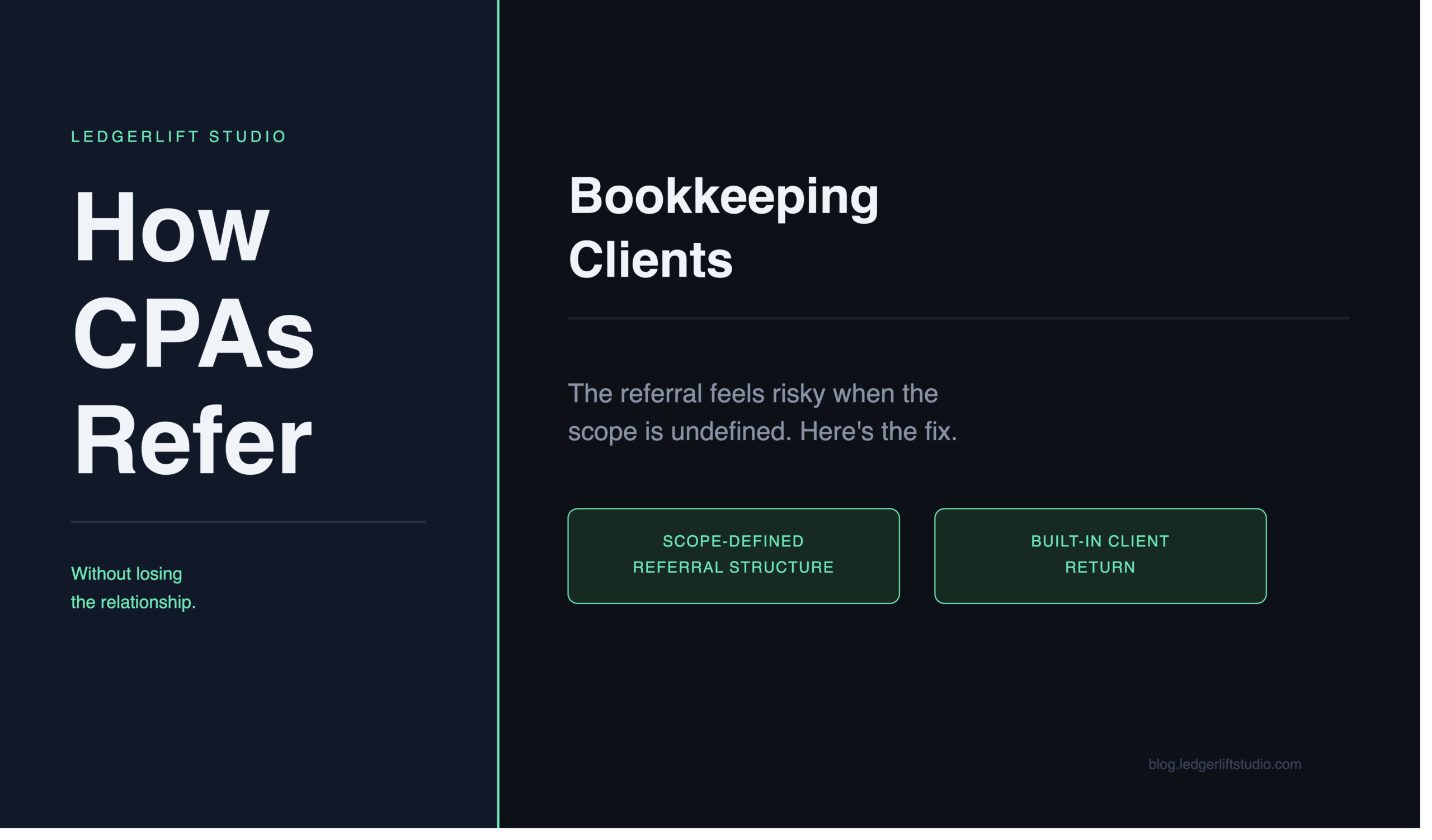
How CPAs Refer Bookkeeping Clients Without Losing the Relationship — Quick Answer
CPAs can refer bookkeeping clients to a bookkeeper without losing the relationship by referring into a scope-defined engagement with a fixed timeline and a built-in return. At LedgerLift Studio, that engagement is the Reset Service: a defined cleanup that returns the client to the CPA clean and tax-ready, rather than disappearing into an open-ended arrangement.
Most CPAs already know the math: clients with messy books cost more time than they’re worth, and clean books make the relationship work. The part that stops a lot of referrals before they happen isn’t the math. It’s the fear that handing a client off means handing the relationship off too.
Learning how to refer bookkeeping clients without losing relationship with them comes down to one thing: scope.
That fear is reasonable. A referral done badly looks like this: you send a client somewhere, they disappear into someone else’s process, and six months later you’re not sure what happened to your client or your books. The CPA-bookkeeper relationship that should have strengthened the client relationship instead created distance from it.
The fix isn’t to stop referring. It’s to refer into a structure that’s built to protect the relationship instead of risking it. That structure is exactly what the Reset Service is built to provide — a defined on-ramp that returns the client to you clean, and opens the door to a system they can actually run the business on.
How to Refer Bookkeeping Clients Without Losing Relationship: The Scope Problem
A referral feels risky when the scope is undefined. If a CPA doesn’t know exactly what the bookkeeper will do, how long it takes, or what the client comes back with, there’s no way to set expectations with the client beforehand. That’s where trust erodes — not because the bookkeeper does bad work, but because nobody could say in advance what “done” would look like.
The referral works when the scope is defined. When a CPA knows exactly what the client comes back with, there’s nothing to wonder about after the introduction is made.
That’s a scope problem, not a trust problem. And it has a scope-shaped solution.
A Scope-Defined Referral Protects the Relationship
LedgerLift Studio runs CPA referrals through a fixed-scope engagement called the Reset. A client with behind books gets a defined cleanup: reconciled accounts, categorized transactions, a clean baseline their CPA can actually use. Nothing open-ended, nothing that drifts into ongoing bookkeeping the CPA never agreed to.
That structure matters because it’s what makes the introduction safe to make. When a CPA refers a client to a fixed-scope engagement with a known outcome, they’re not handing the relationship off — they’re expanding what they can offer the client without taking on work that isn’t theirs to do.
The client doesn’t experience it as a handoff. They experience it as their CPA knowing exactly where to send them. That’s what makes the introduction worth making.
And because the Reset is preparation, not a destination, the client doesn’t disappear into someone else’s ongoing service. They come back. Clean books, ready for their CPA, no permanent third party sitting between the CPA and the client going forward. For clients who are ready to run a real financial system — not just clean books, that’s a separate conversation. The Reset is what makes them ready for it.
How LedgerLift Structures a Referral That Doesn’t Lose the Relationship
A scope-defined referral avoids the open-ended trap by design:
- Fixed timeline. The Reset has a defined engagement period, not an open-ended retainer.
- Defined deliverable. The CPA knows exactly what the client will have at the end — reconciled accounts and a clean baseline, not “improved bookkeeping.”
- Built-in return. The client comes back to the CPA with clean books. The engagement is structured to end, not to continue indefinitely.
- Reciprocal structure. LedgerLift Studio pays a referral fee on every completed Reset engagement — no volume commitments, no locked arrangement. See the full commission structure and payment terms on the CPA referral program page.
None of this requires the CPA to manage the engagement or stay involved day-to-day. They make the introduction, the Reset runs on its own structure, and the client comes back tax-ready.
When to Make the Introduction
The clearest signal: a client shows up with books that are too far behind for the CPA to use as-is — months of uncategorized transactions, accounts that don’t reconcile, no real system behind the numbers. That’s not a CPA problem to fix. It’s a bookkeeping problem with a defined solution.
The introduction itself doesn’t need to be complicated. A short note explaining that the client’s books need a structured cleanup before tax work can move forward, with a clear handoff to the Reset, is enough. The structure does the rest.
Frequently Asked Questions
A: Refer into a scope-defined engagement rather than an open-ended one. When the CPA knows exactly what the client will come back with — a fixed timeline, a defined deliverable, a built-in return — there’s nothing left to wonder about after the introduction. LedgerLift Studio’s Reset Service is structured this way specifically to protect the referring CPA’s relationship with the client.
A: The clearest signal is books too far behind for the CPA to use as-is — months of uncategorized transactions, accounts that don’t reconcile, no real system behind the numbers. That’s a bookkeeping problem, not a CPA problem, and it has a defined solution.
A: Yes — that’s the point of a scope-defined referral. The Reset Service is built with a fixed engagement period and a built-in return: the client comes back with reconciled accounts and a clean baseline, tax-ready for their CPA. It’s preparation, not a destination, so there’s no ongoing third party sitting between the CPA and the client.
A: No — undefined scope is what puts the relationship at risk, not the referral itself. A fixed engagement with a known outcome lets the CPA make the introduction without losing visibility into what happens to the client.
A: LedgerLift Studio pays a referral fee on every completed Reset engagement, with no volume commitments and no locked arrangement. Full commission structure and payment terms are on the CPA referral program page.
The Bottom Line
Referrals don’t put the relationship at risk. Undefined scope does. A fixed engagement with a known outcome and a built-in return is what lets a CPA make the introduction without wondering what happens to the client — or the relationship — after that. The Reset is the on-ramp. For clients ready to build something that runs the business, that’s where it starts. It’s the same reasoning behind why CPAs refer clients to bookkeepers in the first place — the referral only works long-term if the structure protects everyone in it.
Book a partner intro call → Talk through which clients are ready to build a system, and which ones need the structured cleanup first.
Renée Morrison is the founder of LedgerLift Studio. LedgerLift Studio builds custom financial database systems for bootstrap founders. For clients who need it, that starts with a structured cleanup — so the system has a clean foundation to run on.