
Reading time: 3 minutes
Most financial quizzes ask surface-level questions and give you a generic answer. The LedgerLift Studio diagnostic works differently — it measures your bookkeeping maturity stage based on how your finances actually operate, then routes you to the system that fits where you are.
Bookkeeping maturity stage is a diagnostic framework that measures how a founder’s financial operations actually function — not how much revenue they generate.
Here’s exactly what the diagnostic measures and how it determines your result.
The Three Things the Diagnostic Actually Looks At
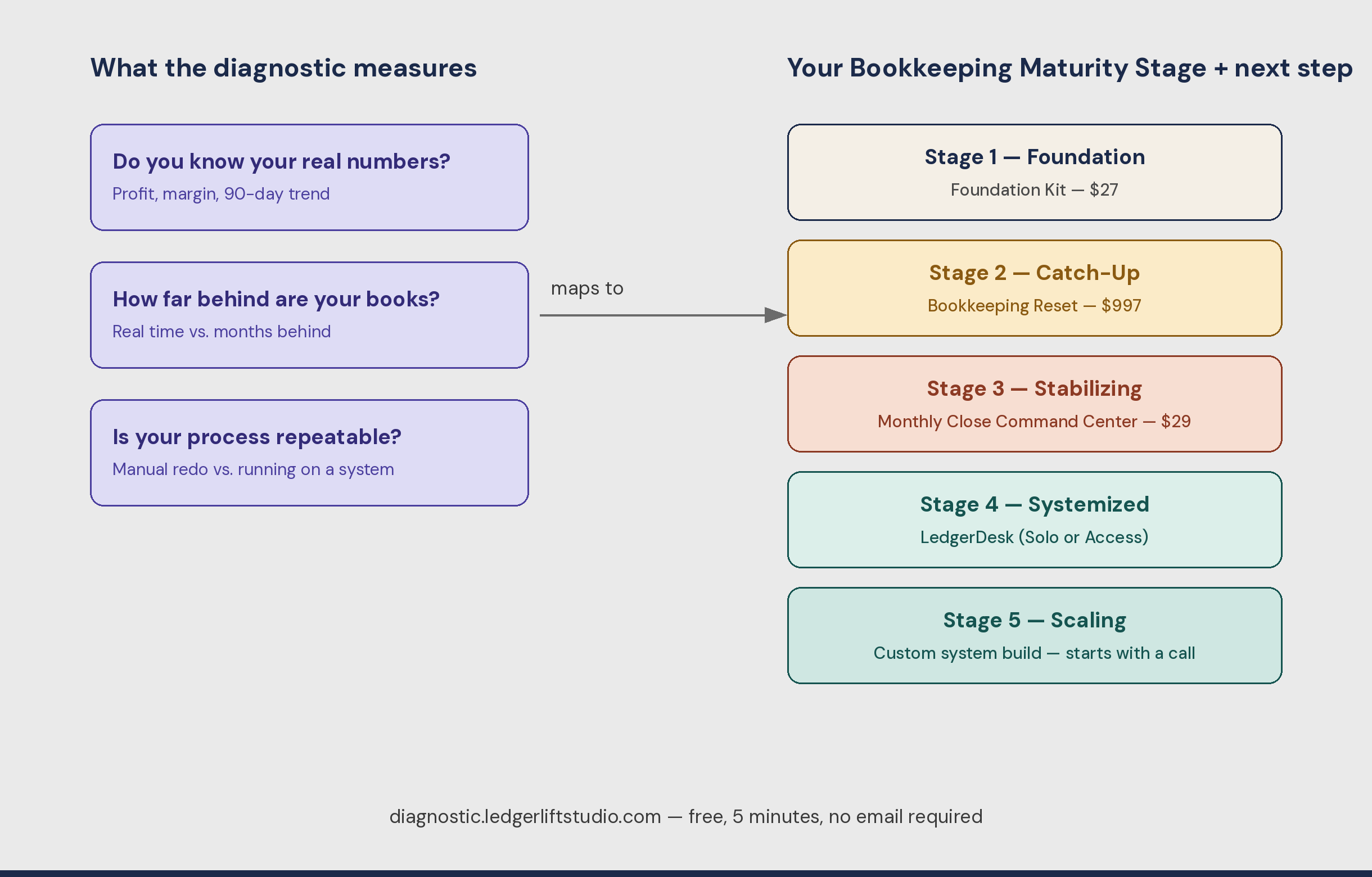
The diagnostic isn’t asking how much money you make. It’s asking how your finances actually run. There are three things it’s built to surface:
Do you know your real numbers? Most founders think they know their numbers. They know their bank balance. They know what came in last month. But do they know their actual profit after expenses? Whether they’re trending up or down? The diagnostic identifies whether you’re operating on real data or educated guesses.
Is your bookkeeping current, or is it behind? There’s a difference between books that are slightly messy and books that are months behind. The diagnostic determines whether you’re maintaining your books in real time, catching up regularly, or carrying a backlog that’s become a real problem.
Is your process repeatable — or are you doing it manually every time? A founder can have current books and still be stuck redoing the same cleanup work every single month. The diagnostic catches the difference between “current” and “running on a system.”
Together, these three measures define your bookkeeping maturity stage.
Why Bookkeeping Maturity Stage Matters More Than Revenue for Founders
This is the part most financial quizzes get wrong: they sort you by revenue. The diagnostic doesn’t, because revenue alone doesn’t tell you what you need.
A founder at $400K with a chaotic spreadsheet and no real system can be Stage 1. A founder at $40K who’s built a tight, repeatable monthly process can be Stage 3. Revenue tells you how much is coming in. Maturity tells you whether you can trust your numbers and what to actually do about it.
The 5 Bookkeeping Maturity Stages — What Each One Means
Your answers map to one of five stages. Each one reflects how your finances actually behave — not your revenue bracket.
Stage 1 — Foundation
No real bookkeeping system, or a spreadsheet that’s more chaos than record. You can’t say with confidence whether you made money last month. Business and personal expenses are mixed together.
Diagnostic result: Foundation Kit ($27) — build financial clarity before anything else.
Stage 2 — Catch-Up
You have some kind of system, but it’s months behind. Transactions are uncategorized, accounts aren’t reconciled, and tax season fills you with dread because you know what’s waiting underneath.
Diagnostic result: Bookkeeping Reset ($997) clears the backlog — then you move into a real system to run on going forward. The Reset isn’t the destination; it’s what makes the next stage possible.
Stage 3 — Stabilizing
Your books are mostly current, but the process isn’t repeatable — you’re still hands-on every single month, redoing work that should run itself. Reports exist, but you don’t fully trust or use them.
Diagnostic result: Monthly Close Command Center ($29) — turn the monthly scramble into a real, repeatable process.
Stage 4 — Systemized
Your books are current and the process mostly works, but you’re managing it with tools that don’t actually fit how your business operates. It’s still taking up too much of your time. One revenue stream, no team (or a very small one) — the problem is tooling and time, not scale.
Diagnostic result: LedgerDesk — a real financial database system built for how your business actually runs, not a generic template.
Stage 5 — Scaling
Multiple revenue streams, possibly a small team. You’ve outgrown what standard bookkeeping tools can handle. What you need isn’t more software — it’s a financial thinking partner who can keep pace with the complexity.
Diagnostic result: Custom system build — scoped to your revenue streams and team. Starts with a call to map the complexity and determine what gets built.
What Happens After You Take the Diagnostic
The diagnostic takes about 2 minutes — five questions, asked one at a time, based on how your finances actually behave, never on revenue. At the end, you get:
- Your Bookkeeping Maturity Stage (1–5)
- A plain-English explanation of what that stage means for your business
- A specific next step — whether that’s foundation work, a one-time cleanup, a repeatable close process, a real system, or a custom build
No email required to see your result. No upsell pressure. Just a direct answer.
Take the Diagnostic
Ready to know where you stand? Take the free LedgerLift Studio diagnostic → and get your clear next step toward a system that actually runs your business.
Not sure which LedgerDesk fits your stage? Read the Airtable vs. Microsoft Access breakdown, or the full product lineup.
Real numbers. Real systems. Built from real books.