
Reading time: 5 minutes
Most founders don’t know which financial system for small business actually fits their stage — and I know that because I made the same mistake when I first started building products.
It didn’t work.
A founder at $15K revenue doesn’t need the same financial system as a founder at $150K revenue. Not because one is better or worse, but because their problems are completely different. The founder trying to figure out if they’re even profitable needs something fast and simple. The founder managing multiple revenue streams and an accountant needs something robust and collaborative.
Every product I sell exists because I kept running into the same founder problem repeatedly, and I built something to solve it.
Here’s what those problems were, and what I built for each one.
The First Problem: ‘I Don’t Know Where to Start’
Most founders I work with have this moment: I’m making money, but I have no idea if I’m actually profitable.
They have receipts. They have bank statements. They just don’t have a system to turn that into real numbers.
For that founder, I built the LedgerLift Studio Foundation Kit ($27).
It’s not a full system. It’s not software. It’s a diagnostic. You answer 15 questions about your money. You walk away knowing your Bookkeeping Maturity Stage and exactly what product you need next. No upsell. No “you need everything.” Just clarity.
This product exists because founders were asking me the same question over and over: “Do I need help, and if so, what kind?” The kit answers that in 15 minutes.
The Second Problem: “I Know I Should Close My Books Every Month, But I Never Do”
Foundation Kit tells a founder where they stand. It doesn’t build the habit of checking back in.
That’s a different problem. A founder takes the diagnostic, gets clarity once, and then goes right back to not looking at their numbers until tax season panic sets in again. Clarity isn’t the same as a rhythm. Without a repeatable monthly process, even a founder who knows exactly where they stand today has no idea where they’ll stand in three months.
For that founder, I built Monthly Close Command Center ($29).
It’s not a full financial database system — that’s the next step, not this one. It’s a structured monthly close workflow: what you made, what you kept, what you owe, run in under an hour. No new software to learn, no database to set up. Just a repeatable process that turns “I should probably check my numbers” into something that actually happens every month.
This product exists because founders kept taking the Foundation Kit diagnostic, getting their answer, and then drifting right back into not knowing. The gap wasn’t information. It was habit.
It costs $29 because it’s a workflow, not a system — cheap enough to be a no-brainer next step after Foundation Kit, before anyone’s ready to commit to a full LedgerDesk build.
The Third Problem: ‘I Need a Real System But I Don’t Want to Pay Monthly’
After founders take the diagnostic, some realize they need an actual financial system, something that runs their business, not just a one-time answer.
Enter LedgerDesk Solo ($197).
This is a pre-built Airtable database. You copy it, plug in your numbers, and you have a working financial system. Real-time P&L. Income tracking by source. Expense breakdown. Everything you need to actually run the business.
Why Airtable? Because it’s accessible, it’s affordable, and most founders can learn it. And because I built this system from 15+ years of real founder books every field, every formula, every automation exists because it solved an actual problem.
This product costs $197 one-time because that’s what it should cost. A bookkeeper would charge you $500–$1,500/month. This system runs for years. You own it forever.
The Fourth Problem: ‘My Books Are Getting Complex’
As founders scale, their needs shift. More transactions. More complexity. Sometimes they need someone else (an accountant, a partner) to actually access the files.
For that founder, I built LedgerDesk Access ($147).
Same system as Solo, different engine. Microsoft Access handles more volume, more simultaneous users, local file storage. It’s the choice for founders past $200K revenue who need something that scales without breaking.
Not sure whether Solo or Access is the right financial system for small business at your stage? See the full Airtable vs Access breakdown before you decide.
This costs $147 because Access requires fewer cloud subscriptions and handles higher complexity. You own it forever, just like Solo.
The Fifth Problem: “My Books Are Too Broken to Fix Myself”
Here’s where Reset Service comes in.
I’ve tried to build LedgerDesk systems on top of messy books. It never works. The system just inherits all the old mistakes.
So if you’re over $200K revenue and your books are genuinely broken — mixed personal/business transactions, missing categories, unreconciled accounts — you can’t skip cleanup. You have to fix it first.
Reset Service ($997) is what that costs.
I audit your records, recategorize everything, reconcile your accounts, and set up your LedgerDesk so you launch on a foundation that actually works. Then I walk you through what was broken and why.
Reset Service is not a destination product. It’s a prerequisite. It exists so you can build a real financial system for small business that actually runs your operations.
So Which One Is Actually Right for You?
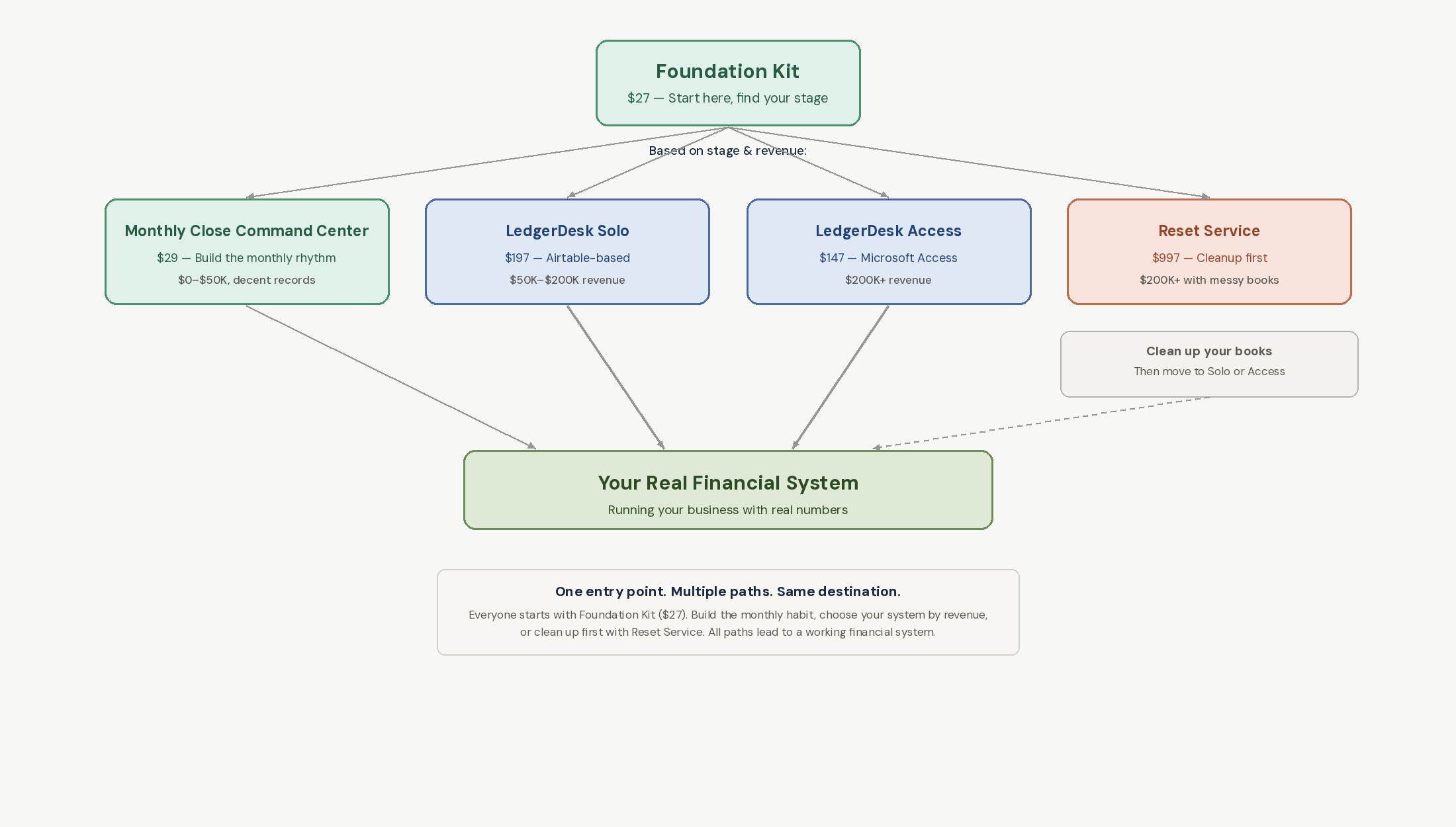
Start with the Foundation Kit if you’ve never done your books properly. $27 answers the question: “Do I need help, and what kind?”
Not sure where you land? Take the free two-minute diagnostic.
Then:
Have decent records but need a monthly rhythm before a full system? → Monthly Close Command Center ($29)
$50K–$200K and use Airtable → LedgerDesk Solo ($197)
$200K+ and need multi-user access or local storage → LedgerDesk Access ($147)
Books too messy to sort yourself → Reset Service ($997) first — it prepares you for a LedgerDesk system that actually runs your business
Every product I built exists because a real founder needed it. Every price reflects what that solution actually costs to build and deliver.
That’s it. Five products, five problems, no guessing.
Real numbers. Real systems. Built from real books.