
If you’re a CPA who’s referred a client to a custom bookkeeping database, or you’re about to, there’s a fair question sitting underneath the recommendation. Once it’s built, does someone have to keep maintaining it — and if so, who?
Here’s a direct answer.
Does a custom bookkeeping system need ongoing maintenance? No, not on any fixed schedule. A LedgerDesk system doesn’t require upkeep to keep functioning day to day. It only needs structural attention — adjusting categories, formulas, or views — when the underlying business changes enough to outgrow the original setup. That attention is optional and founder-initiated, not a recurring obligation.
What “maintenance” actually means for a custom database
A LedgerDesk system isn’t software that updates itself in the background. It’s a structured build — tables, formulas, categorization logic — that matches how a specific business runs. Maintenance here doesn’t mean patches or version upgrades. It means two different things, and CPAs vetting a system should separate them:
- Data entry and categorization — the ongoing, monthly work of recording transactions and keeping the books current. This is bookkeeping, not system maintenance, and it’s the founder’s responsibility (or their bookkeeper’s) regardless of what platform the system runs on.
- Structural maintenance — adjusting the system itself when the business changes: a new revenue stream, a new expense category, a pricing model shift, a change in team size. This is the part that actually resembles “maintaining a database,” and it’s what this post addresses.
Conflating the two is where confusion usually starts. A founder can keep their books perfectly current every month and still leave the system’s structure untouched since the day it was built. That’s fine, right up until the business changes shape.
Does the founder need to touch the structure themselves?
No, and this is worth being precise about. LedgerLift Studio hands over every LedgerDesk system with full founder-level ownership — the same answer this series covered on the security question. A custom database can lock to founder-only access, and LedgerLift Studio keeps no login after delivery. The founder owns the base or database outright. That means they can modify the structure themselves if they’re comfortable in Airtable or Access. It doesn’t mean they have to.
Most founders don’t rebuild their own chart of accounts structure any more than they’d rewrite their own QuickBooks chart of accounts from scratch. They use the system from day one and come back for structural changes only when something in the business shifts enough to warrant it — not on a fixed schedule.
When structural maintenance actually comes up
In practice, a LedgerDesk system needs structural attention when:
- The founder adds a new product line, service, or revenue stream that doesn’t fit existing categories
- Pricing model changes (subscription to one-time, for example) in a way that breaks existing formulas or views
- Team size changes enough to require new permission tiers or access levels
- The founder’s reporting needs grow — they want a view or rollup the original build didn’t anticipate
- An annual or semi-annual check-in surfaces drift between how the business runs now and how the founder originally structured the system
None of these are urgent, all-hands problems. They’re normal evolution — the same reason a growing business eventually revisits its QuickBooks chart of accounts too.
Airtable vs. Access: does maintenance differ by platform?
Yes, and it breaks down the same way the security question did. Airtable’s hosted infrastructure works differently than Access’s local, device-dependent setup.
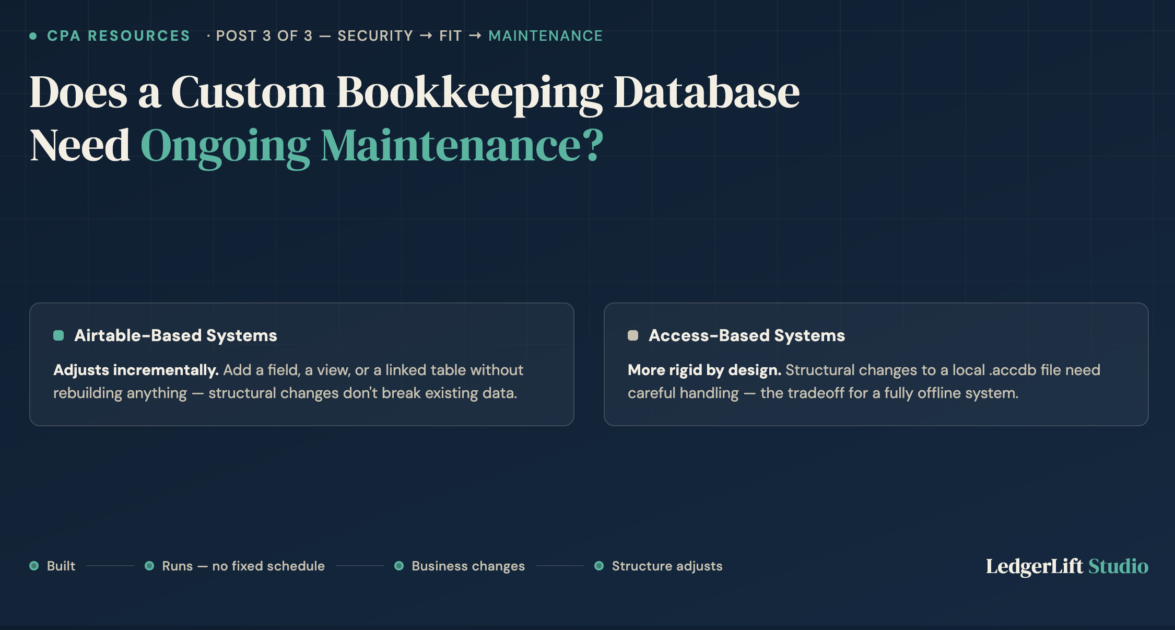
Airtable-based systems are easier to adjust incrementally. Adding a field, a view, or a linked table doesn’t require rebuilding anything — Airtable’s interface supports iterative structural changes without breaking existing data.
Access-based systems are more rigid by design. Structural changes to an .accdb file — new tables, relationships, or queries — typically require more careful handling. Skip that care and you risk breaking existing forms or reports.
Neither platform requires scheduled maintenance the way software with security patches does. Both can sit untouched indefinitely without degrading — the question is only whether the structure still matches the business.
What this means for a CPA’s recommendation
If a client asks “will I be stuck maintaining this myself,” the honest answer is: mostly no. The system doesn’t require upkeep to keep functioning. It requires occasional structural attention when the business itself changes — and that’s optional, founder-initiated, not a recurring obligation that comes with owning the system.
If a client’s business is unusually fast-changing — frequent pivots, rapid team growth, new revenue lines every quarter — flag that in the referral conversation. It’s not that the system can’t handle it. It just means more frequent structural check-ins may be worth planning for.
Where this fits in the process
This is the third piece of the same vetting picture as Post 1 and Post 2. Is it secure? Does it fit this founder better than QuickBooks? And now — does it create an ongoing maintenance burden? Together, the three answer what a CPA actually needs before referring a client with confidence.
For a founder whose business has changed enough that the original system structure no longer fits, that’s not something to troubleshoot piecemeal. A LedgerDesk Custom scoping call is where that gets sorted out. The founder or their CPA walks through what’s shifted — multiple revenue streams, job costing, inventory, or split entities — and LedgerLift Studio establishes whether the system needs adjusting or rebuilding to match, rather than leaving a structure that no longer fits the business it’s running.
FAQ
A: The system doesn’t require ongoing maintenance to keep functioning. You only need structural changes when your business changes enough to outgrow the original setup — new revenue streams, pricing changes, or team growth. Even then, it’s optional and founder-initiated, not scheduled upkeep.
A: Neither needs scheduled maintenance. Airtable-based systems are easier to adjust incrementally when you need to make changes. Access-based systems are more rigid by design, since structural changes to a local .accdb file require more careful handling — a tradeoff for being fully offline with no platform dependency.
A: That’s a structural update, not a maintenance emergency. A LedgerDesk Custom scoping call is the right next step — a scoped conversation to establish what’s changed and whether the system needs adjusting or rebuilding to match.
Real numbers. Real systems. Built from real books.